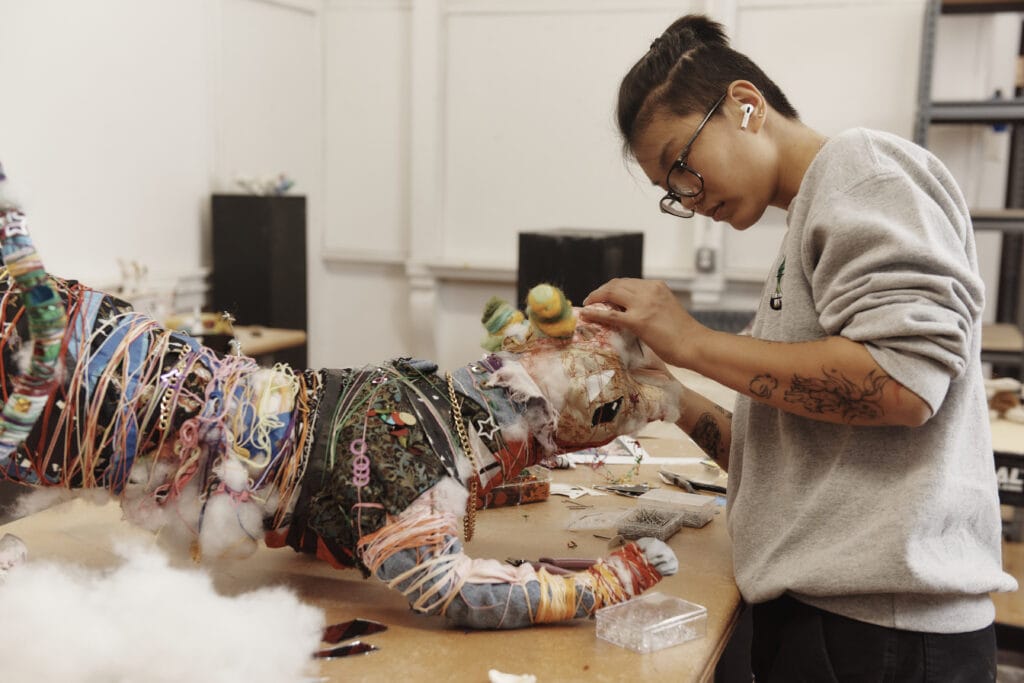
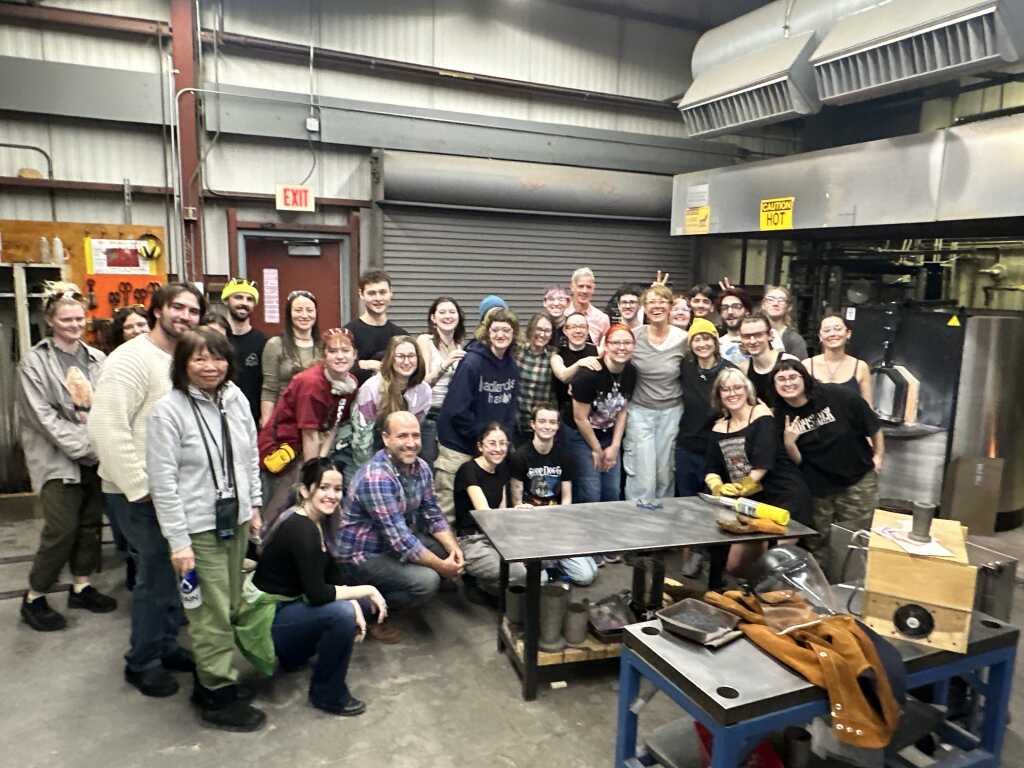
Bringing Glass to Life: Tracy Silva Barbosa’s Journey from New Bedford to MassArt
MassArt alumna Tracy Silva Barbosa on her journey from New Bedford to becoming a glass artist.
View story
Architect Michael Plofker reflects on historic preservation in New York City, Plaza Hotel restoration, and Lincoln Center/66th Street subway station underground gallery.
Through his work with Rudin Management, Michael helped steward the 241 Central Park West project, a major historic restoration on the Upper West Side in New York City, which was done in coordination with the State Historic Preservation Offices. Photo Credit: Rudin Management.
Written by Rachael Dubinsky
Michael Plofker BFA ’76 has always seen the world through what he calls “3D glasses.” An architect, an artist, and a devoted New Yorker, Plofker has built a career at the intersection of design, craft, and civic pride. From welding and home building to historical restoration and unofficial archivist, his work has left a lasting mark on some of New York City’s most iconic spaces—including the Plaza Hotel and the Lincoln Center/66th Street subway station.
While he didn’t start his college career at MassArt, through happenstance he found himself drawn to the College’s small size and focus on the intersection between art and design. As a double major in architectural design and sculpture, Michael developed a way of thinking that continues to shape his practice decades later.
“My father was an engineer, and while I didn’t follow that exact path, my career has led me to work very closely with a variety of engineers, tradespeople, architects, and artists,” said Michael. “That close collaboration and dedication to historic preservation and the civic good is what enables amazing work to be done in the design field.”
Image courtesy of Michael Plofker.
The road that would ultimately bring Michael back to New York City was a winding but rewarding one. After graduating, he got a job as a welder making traveling stage sets for musicians while living in Somerville, Mass. It was in that role that he wound up fabricating a platform for Elton John as part of a themed tour celebrating the 200th anniversary of the Declaration of Independence. The platform included a rail to hang onto as it rose above the stage with Elton John dressed as the Statue of Liberty. However, Michael hadn’t considered Elton’s shorter stature and the height of the stand had to be adjusted by six inches at the last minute for Elton to be able to use it.
“In a high pressure situation like that I truly learned to make mistakes and find ways to “make the show go on,” said Michael. This wasn’t the last time he would find collaborative work in theater design.
After a stint in building homes in Colorado, Michael returned to New York City in the 1980s, a pivotal moment when architects were helping the city rebound from its post-recession years. Working for architecture firms during this time taught him the business of architecture at full speed—often moving from one office-building project to the next every few months.
One job, however, stood out. A mysterious phone call instructed Michael to bring his chainsaw to a construction site on Water Street. During excavation, workers had uncovered an old ship, and Michael was tasked with separating the bow for posterity so the project could continue. The experience sparked a deeper appreciation for the role archaeology can play in architecture—and for the layers of history beneath New York’s streets.
That deep appreciation of history would serve him well in the 1990s, when Michael landed what many New York City architects would consider a dream job: restoring portions of the Park Plaza. Focused on the building’s ground floor and exterior, the work demanded a precise balance between classic craftsmanship and contemporary materials.

Greenwich Lane, one of Michael’s final projects before retirement, united four landmark building façades with a new residential tower into a single, cohesive structure spanning nearly three-quarters of a million square feet. Photo Credit: LX Collection.
Michael’s attention to detail served him well throughout the project. One particularly rewarding challenge was determining the historically accurate placement of the Gatsby Suite. This meant rereading The Great Gatsby, combing through old magazine spreads, and digging deep into city archives. Eventually, Michael and his colleague were able to get their hands on all of the original structural drawings for the Plaza. Today, you can experience the palm court dome reimagined from archival photos and pieces of original glass found from its demolition in 1943.
Michael worked on the historic restoration of the Plaza Hotel’s Palm Court using original glass for its 1943 demolition.
Michael worked with Lincoln Center/66th Street subway station. Photo credits: David Reynolds and Gale S. Hanaratty.
Another standout project was his work on the Lincoln Center/66th Street subway station as part of the MTA’s restoration efforts in the 1990s. Unlike Manhattan’s soaring skyscrapers, this project required reimagining a subterranean public space—not just for safety and cleanliness, but as a welcoming, cultural destination.
Thanks to New York City’s Percent for Art program, artist Nancy Spero created the “Artemis, Acrobats, Divas, and Dancers” installation, which stretches the entire subway station, transforming it into a full-scale underground gallery. The result is a powerful example of how architecture and art can work together to elevate everyday spaces.
From MassArt studios to some of New York City’s most celebrated landmarks, Michael has built a career rooted in curiosity, collaboration, and craftsmanship.
His advice to emerging designers? “Stay curious. Think like an investigator,” he said. “And always stay open to something new.”
MassArt alumna Tracy Silva Barbosa on her journey from New Bedford to becoming a glass artist.
View story
MassArt and TERC bring creative installations together with research on soundscapes and learning.
View story