Written by Rachael Dubinsky
MassArt students with overlapping interests in art and science can often generate exciting new lines of creative work. Studio for Interrelated Media (SIM) has been teaching the interrelationship between art and science for over 50 years. MassArt students are invited to observe, experiment, and invent ArtScience concepts and natural phenomena through courses like “Nature, Science, and Art”, “Electronic Projects”, and “Observation Data and Art”.
That same spirit of curiosity about the interplay between art and science sits at the heart of Sound Travels, based at TERC, a STEM education nonprofit in Cambridge, Massachusetts. Led by alumna Martha Merson BFA ’07, and with a grant from the National Science Foundation, the Sound Travels project has brought together scientists, educators, designers, and the MassArt community to explore how sound affects learning experiences —especially in informal community settings like parks, nature centers, museums, and neighborhood streets.
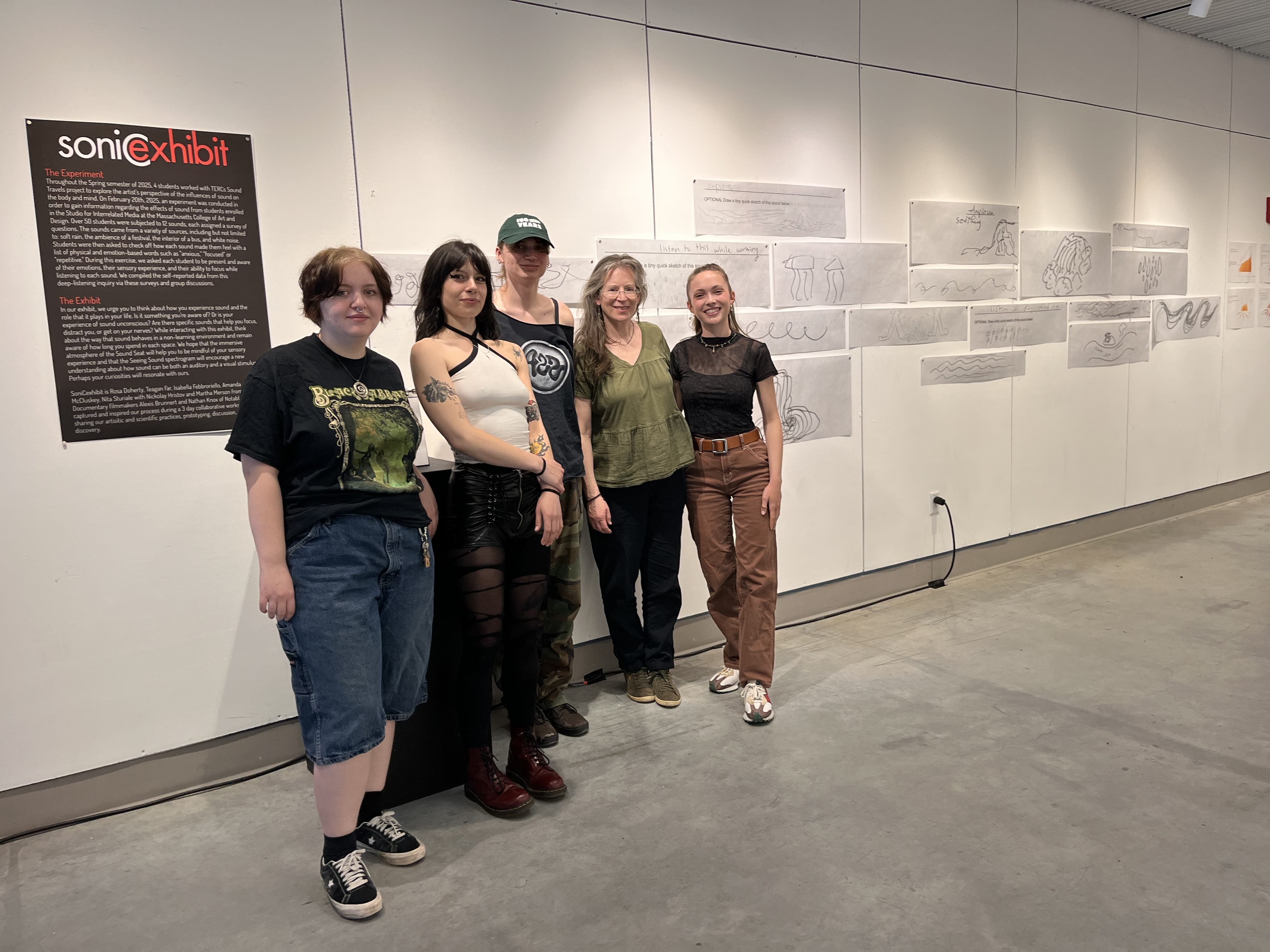
MassArt students, alumni, and faculty have been instrumental in bringing creative installations together with research on soundscapes and learning. Initially Martha reached out to MassArt’s SIM chair, Nita Sturiale, to collaborate, bringing SIM students and alumni into the project. Rosa Doherty BFA ‘25, Teagan Far BFA ‘26, Isabella Febbriorella BFA ‘25, and Amanda McCluskey BFA ‘25 all took on different roles in an independent study focused on how sound affects focus and emotion. Their work moved from a seminar and exhibit on campus to public events, participatory experiences, and collaborative sound-based exploration.
The MassArt students collected emotional-response data from peers, then transformed those insights into SonicExhibit, an interactive installation series designed to spark dialogue among visitors. MassArt community members became active co-creators—testing sounds, comparing reactions, and discussing what made them feel grounded, curious, or unsettled.
As part of the SonicExhibit, Isabella welcomed fellow students to take a seat in a glowing orange-lit salon chair with spherical speakers—immersed blindfolded participants heard soft conversation, birdsong, and flowing water. Some felt refreshed, others uneasy. Excluding one sense (vision) is one way to heighten other senses. “Sound is predictably and unpredictably subjective,” Isabella noted.
Proposing prompts or auditory challenges with real-time feedback can heighten sensitivity and real-time feedback offers a pathway to becoming more sonically sophisticated. In a nearby installation, passersby “painted” with sound using a projected spectrogram, competing playfully to create the boldest visual signatures. Isabella, Amanda, and Teagan were on hand to encourage visitors to talk with one another about perception, comfort, and how sound shapes personal and shared experiences.